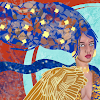
Empire Building
I had a long urge to travel to Sweden and finally lived the dream of driving through the countryside with my daughters. We stopped at Vadstena Castle on the edge of Lake Vättern. As my fingers grazed the whitewash and my feet climbed the stairs, I learned of King Gustav, who built the fortress to guard against menacing Danes. The place is ornate—because that is the point of a castle: to be over the top. I admired the furnishings, but I was drawn most to the artwork of Venus on the walls.
The discrepancy caught me: Greek mythology in Sweden, Venus stroking Eros’s back. Jesus and Mary, too, always feel out of place here—desert figures displayed in the cold north—but I’ve grown used to seeing them everywhere. Venus, though, was strange. The Norse already had their own love goddess, Freyja, love manifest like Venus. Why import another, when a local one was available? I imagine Freyja prowling outside the walls, waiting to be let in.
But Venus is not here for love. She is an icon of empire, part of the package deal with Mary and Jesus. Once a king signed on for that package, art and architecture were decided for him. Local gods became gauche, and Christianity—with its Greek trappings—became the symbol of wealth and power. Christianity is the ultimate form of gentrification.
As I gazed at Venus, I imagined how the “empire package” might have been pitched to some nameless northern king. A monk arrives on his donkey long before Gustav’s castle was ever thought of. He starts boldly: What about, he smirks, control of the peasants with the promise of salvation and the threat of guilt—something your local gods do not offer? Add local support from foreign kings, and you’re rabble gets wild.
The king frowns, he is fond of Odin and Thor, but he tired of rebellions. The monk continues, rolling up his sleeves like any good salesman: And no need to fuss over art—the package includes jaw-dropping architecture and, for your convenience, blessed holy water. He produces a small bottle for effect.
He takes a breath and presses on. But wait—there’s more! Christianity offers a proven system of guilt and salvation to keep the masses in line. You gain tithes, scribes, priests on call, and dynastic security for your heirs.
When the kings of the north converted, they solidified their power. The chaos of local gods and oral traditions was gradually swept into the gentrification of Christianity.
Christianity’s roots are Greek. The connection of Eros, Venus, and even Jesus reveals the foundation of empire-building: Logos. The Greek philosophers revered it. Plato—logic king himself—offered a vision of order irresistible to empire builders. To step into Logos was to be free of chaos, the void within and without. Logos promised streets in lines, square buildings, straight columns. No witches leaping bonfires. No eight-legged horses pounding across the night sky.
The Romans adopted Logos and scaled it into an empire; the Christians then recycled it for their own imperial package.
Logos counters the illogical. Yet after a lifetime bound by logic, to step into illogic is terrifying: the void, the strange gods, the chaos of one’s own rage. Polytheistic traditions—and even the teachings of Jesus—are rife with this illogic. How do we logically explain the resurrection, or magical animals born from blood?
Our minds have flattened under logic. We are linear and algorithmic. We have shelved myth and poetry as untrue, while secretly longing for their depths. But without guides, we fear we will be swept away.
So, I invite Freyja back to the castle walls. I put my hands on the stone. She is not interested in fortresses or churches; she prefers the moat. Still, the paintings of Venus make her smile. She notices how Venus with Eros mirrors Mary with Jesus.
Perhaps she climbs to the top floor of the chapel. She sits quietly on a pew, no need for grandeur. She says: I have no logic. I am spirit, I am the void, I am gold, I am generous. I am love manifest.
She does not care how you decorate your chapel or your home. She is paradox. She does not need a church. I hear the fine golden bells in her hair as she turns her head. She wanders through the marsh houses, blessing the land and tending the dead. Her body is the land itself, and magic pours from her throat.